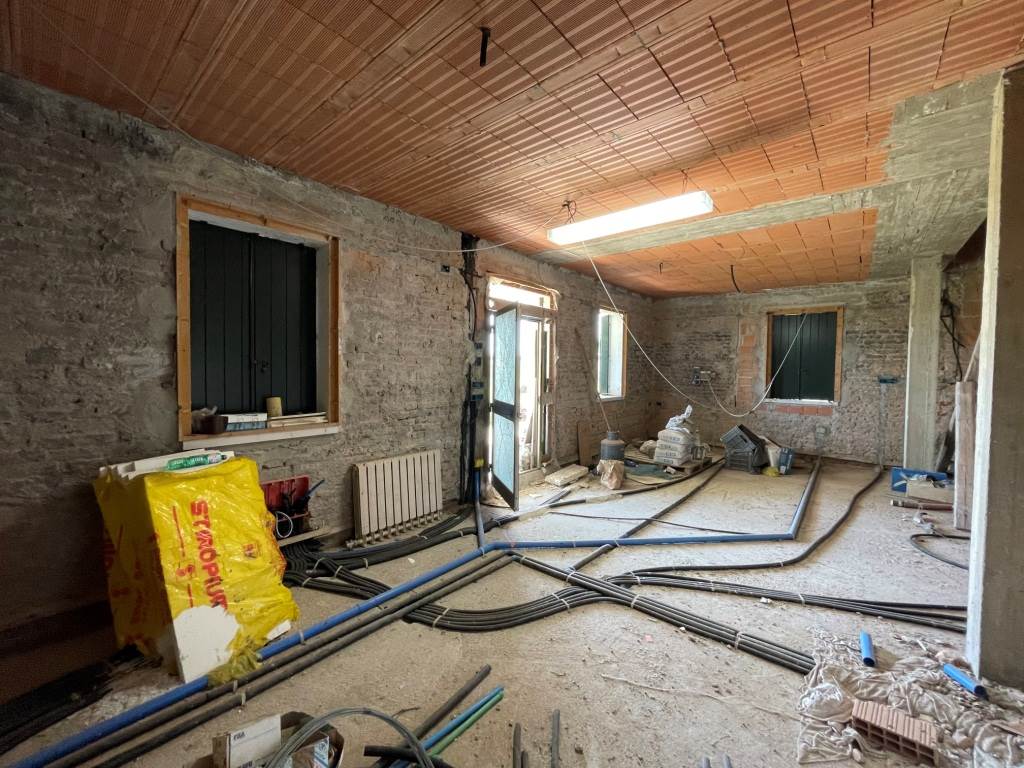
In the area of Canal di Valle, we propose a single house of over 140 square meters on two levels with a spacious porch of another 27 square meters with access to the surrounding land. The house is sold in advanced rough condition, internally composed of an open space living area, a bathroom, and a garage of 31 square meters; on the first floor, there are two bedrooms and a bathroom.
City Information
With its 49,405 inhabitants, it is the sixth most populous city in Veneto. Located at the southernmost tip of the Venice Lagoon, it occupies a unique geographical position: between the sea and the lagoon, almost suspended between different shades of blue of the sky and water. Separated from the sea by a long stretch of sandy beach, the lido of Sottomarina extends from the mouth of the port of San Felice to the mouth of the Brenta. Its urban shape, or the structure of the city, has always intrigued scholars, travelers, and writers, to the point of considering it a classic and highly cited example of urban layout, an incomparable synthesis of natural morphology and functionality with respect to the typical trade, fishing. The vertical lines of the square and canals intersect with the horizontal lines of the streets, arranged with regularity and in an almost perfect order to form the classic fishbone pattern. It is an artificial island: since the mid-1500s, when the Cava canal was excavated for military security reasons of the Republic of Venice, of which it was the second city. Since the mid-1700s, it has regained its natural continuity with the mainland through an ancient bridge with 43 arches, now renovated and adapted to modern mobility needs, a place from which one can admire extraordinary fiery sunsets over the lagoon. The Corso del Popolo runs through the historic center of Chioggia from north to south. It is the true heart of the city. It has a double entrance: from the water at the Vigo dock, where the majestic decorated bridge rises, a true balcony over the lagoon, and from the land through the Santa Maria gate, a remnant of ancient medieval walls. A majestic and lived-in square-street, measuring 840 meters in length. It constitutes the cardo maximus of the Roman castrum. One of its most striking features is the continuous series of porticoes on the western side. In the northernmost section, the layout curves by about five degrees, just enough to break the direct gusts of the bora wind. Curzio Malaparte defined it as a unique great café outdoors. A place of animation and social life that gives the impression that every day is a celebration.